Network filtering
A sandbox profile's network axis controls where an agent's traffic may go.
tclaude’s built-in sandbox enforces it with one of two engines: a packet
engine (the Linux default — a private network namespace with a default-drop firewall and a DNS broker) and a proxy engine
(network.engine: "proxy" — an empty namespace whose only way out is a
filtering proxy that decides on the name the client asked for). One launch
uses exactly one engine; combining them is refused.
This page covers how profiles express network policy, how each engine enforces it, and where each engine's guarantees end. The profile model itself is on the sandboxing page.
Expressing policy in a profile
A profile's network block authors a baseline — inherit, allow, or
deny (the legacy network_access: internet|none spelling is still
accepted) — plus allow and deny rows. Composed across scopes, the rules
resolve each launch to an effective open, closed, or list-filtered posture.
Rows are built from these selectors:
host— an exact DNS name.domain— a DNS domain, optionally withinclude_subdomains; matching is label-bound, soexample.comnever matchesnotexample.com.cidr— IP-literal packet authority. A CIDR row carries no DNS authority: it does not admit DNS names whose answers happen to fall inside it.loopback— the host's own loopback services.ports[]— TCP and UDP both (QUIC counts as UDP); empty means all ports.
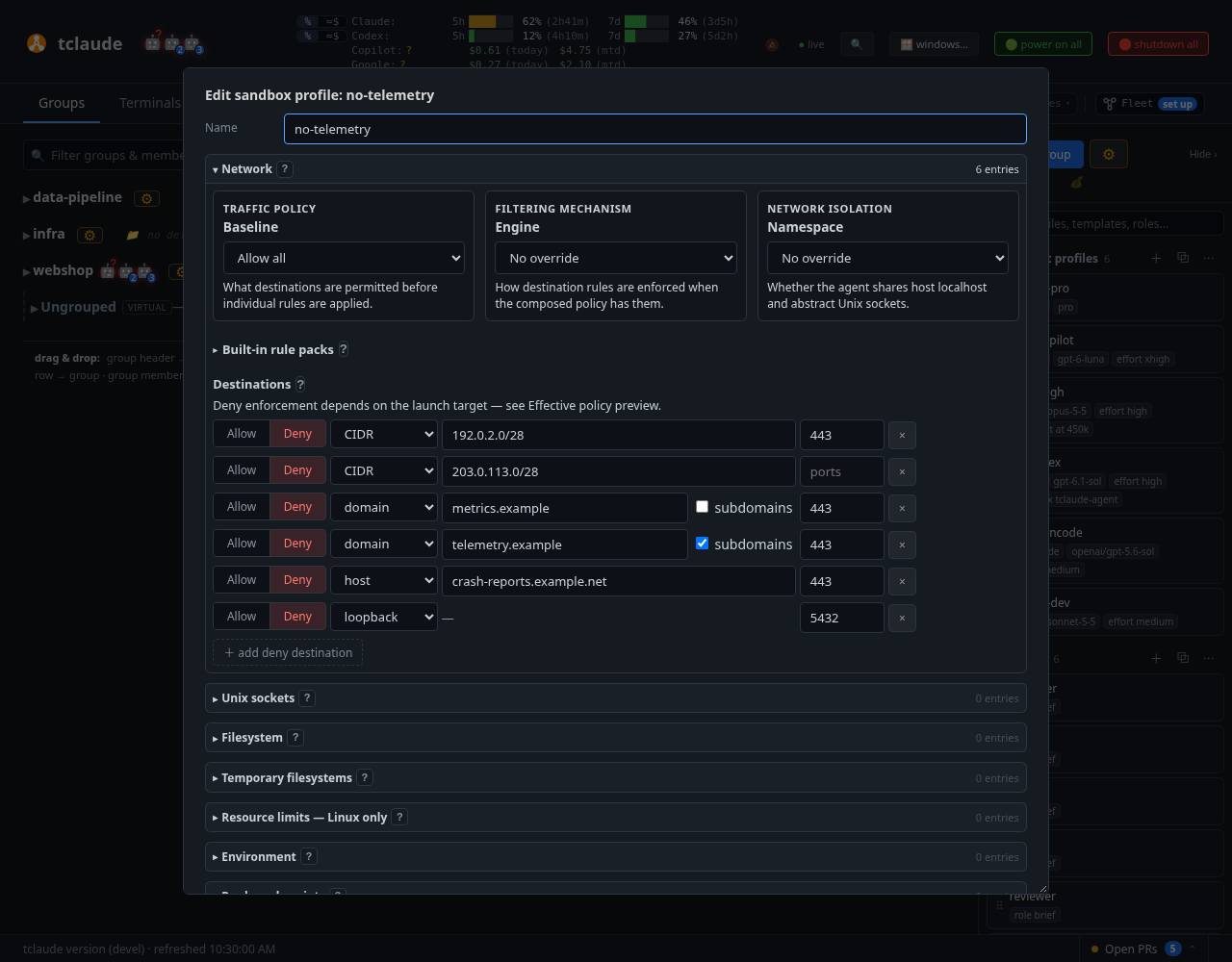
The sandbox-profile network editor: baseline, engine, and namespace selectors above authored deny rows
Deny rows compose as a union and win every overlap; rule order is irrelevant. Under a deny baseline, allow rows are unlocks; under an allow baseline, deny rows are restrictions — the editor labels the redundant cases instead of rejecting them.
Packs
Rather than hand-maintaining vendor endpoints, profiles reference release-owned packs, stored as stable IDs, expanded at resolution time, and frozen into launch snapshots. The current registry:
| Pack | Covers |
|---|---|
net-local |
Unscoped loopback — local model servers (Ollama, LM Studio, llama.cpp), Codex OSS mode, host-local dev services |
net-anthropic |
Claude Code with an API key or a Claude subscription sign-in (api.anthropic.com:443, plus platform.claude.com:443, where a subscription login refreshes its token) |
net-openai-codex |
Direct OpenAI API-key endpoints (api.openai.com:443) |
net-openai-chatgpt |
ChatGPT-signed-in Codex (chatgpt.com:443, auth.openai.com:443) |
net-github-copilot |
GitHub Copilot CLI model and auth traffic |
net-google-gemini-api |
Gemini CLI signed in with an API key (generativelanguage.googleapis.com:443) |
net-google-gemini-login |
Gemini CLI signed in with Google (cloudcode-pa.googleapis.com:443, oauth2.googleapis.com:443) |
net-github |
GitHub (github.com, api.github.com, and friends) |
net-go-modules |
The Go module proxy and checksum database |
net-npm |
The npm registry |
deny_packs is the mirror image. New Deny-all drafts pre-select net-local,
net-anthropic, net-openai-codex, and net-openai-chatgpt; the packs stay
ordinary editable choices afterward. The saved shape keeps intent rather than
copying endpoints:
{
  "network": {
    "baseline": "deny",
    "packs": ["net-local", "net-anthropic", "net-github"],
    "deny_packs": ["net-npm"],
    "allow": [{"domain": "example.internal", "ports": [443]}],
    "deny": [{"host": "telemetry.example.internal"}]
  }
}
Namespace, and the unix-socket axis
network.namespace is independent of the baseline: host shares the host
network; private gives the launch its own Linux network namespace routed
through pasta with default-accept — it separates abstract Unix sockets and
host loopback from the agent without making IP traffic deny-by-default. It is
supported with tclaude’s sandbox alone on Linux for Claude Code, Codex,
OpenCode, Copilot, Gemini CLI, pi and shell launches, and refuses elsewhere rather than falling back. A private
namespace in a global or included profile cannot be widened by a child.
The unix_sockets axis (mode: open|closed|list plus path/path_glob
entries; ** refused; the agentd socket is a non-removable floor) governs
filesystem Unix sockets. Authoring it as closed or a list on an otherwise
host-open profile gets a host-network constructed root on Linux: a fresh
filesystem root and PID namespace with the listed sockets bound back, but no
network namespace — host IP networking and the IDE bridge keep working. That
posture is permanently rated partially enforced: with the host network
namespace shared, abstract-namespace sockets (@…) are not filesystem objects
and no mount plan can hide them. Close network access too if those must be
confined.
Composition across scopes
Allow authority intersects across the global, group, and explicit tiers while
deny authority unions — (B1−D1)∩(B2−D2) = (B1∩B2)−(D1∪D2) — and closed
dominates. Unix-socket lists intersect. network.engine is the one precedence
field: most explicit wins (explicit > group > global), with a disclosure when
composition was overridden.
Because allow lists intersect, a destination is reachable only if every
tier that authors an allow list allows it. A group profile cannot add a host
that the global profile's list leaves out. When two or more tiers author lists
and the intersection drops entries, the resolved profile carries a composition
warning that names, per tier, what was dropped or narrowed. The spawn dialog,
the profile editor and tclaude agent sandbox-profiles plan show it. If the
dropped entry is the harness's model endpoint, the model-transport refusal
below names the tier that allowed it and the tier that did not. Fix it in the
tier that lacks it, or give the global tier no list (baseline: "allow" or no
network policy) so the group list alone decides.
The three postures
- Open baseline (or omitted / legacy
internet) → host-open: the host network namespace, host loopback services and ambient Unix sockets included. Ambient privileged sockets such asdocker.sockare a named residual under an inherited root. - Closed (
none) → isolated-with-agentd: a fresh network namespace with only loopback up, a fresh PID namespace, and a constructed root with the agentd socket bound read-only. This severs IDE bridges and host-local model servers, so hosted-only harnesses are refused outright; Codex proceeds only with the explicitTCLAUDE_OFFLINE_MODEL=1operator assertion. On macOS, Seatbelt denies outbound and bind (agentd socket excepted) but provides no PID isolation, no constructed root, and — deliberately — no loopback exception. The dashboard spawn dialog's "Allow launch with unenforced rules" checkbox can widen this closed-network gap for one fresh launch, never saved or inherited, recorded asoperator_unenforced_launch_override. - List → filtered, through whichever engine the profile deploys.
The packet engine
The Linux default for a list or deny policy under tclaude’s sandbox. Four building blocks, assembled per launch:
- bubblewrap creates user, network, PID, and mount namespaces with no connectivity, presenting the harness as the invoking numeric UID/GID. Files created in authorized host binds therefore remain owned by that host identity.
- The outside supervisor joins the user namespace that owns the network
namespace, then installs a default-drop nftables output policy
(
inet tclaude_filter) as one atomic transaction with timed per-rule IPv4/IPv6 sets. The sandbox bootstrap holds no capabilities, drops and verifies all capability sets, sets no-new-privileges, and gates the harness until setup completes. - Rootless pasta provides outbound-only connectivity — no inbound forwards, no splice shortcuts. Harness exec is gated until the policy and pasta are both verified; if pasta or the broker dies, the supervisor kills the sandbox. In caller-identity mode the supervisor starts pasta from the network namespace's owning user namespace before it joins the nested network namespace; this keeps pasta and nft authority independent of the harness identity.
- A tclaude DNS broker at
127.0.0.53(a real listener on port 1053 behind an nft redirect) answers only authored names. Each admitted A/AAAA answer is leased into the matching nft set for the observed DNS TTL, capped at one hour. Sealed memfds pin the nft batch and the sandbox's/etc/hosts/resolv.conf, so a hosts-file mapping cannot bypass the selectors. SVCB/HTTPS records are stripped, which blocks ECH config delivery and keeps TLS SNI observable — defense-in-depth.
DNS names are enforced at the DNS-to-IP boundary: an allowed name admits
the addresses its lookup returned, so another site hosted on a shared IP is
also reachable until the lease expires, and an established connection survives
expiry. New flows always need a current lease — an agent that performs no
fresh lookup after expiry cannot open another connection. Host, domain, CIDR,
and loopback selectors rate Full with that boundary stated; DNS-name deny
rows are Full under a deny baseline and Partial under an allow baseline
(another address for the same service, or encrypted DNS that bypasses the
broker, can remain reachable).
Host-loopback rows map to the synthetic name host.tclaude.internal
(169.254.2.2 / fd00::2), filtered by the authored ports; 127.0.0.1 and
::1 stay private to the sandbox. Known gap: the synthetic addresses are not
reserved from CIDR or DNS-derived rules, so either kind of rule can also reach
host loopback on its authored ports — a DNS-rebinding route to host services.
The packet engine is enforced with tclaude’s sandbox alone for Claude Code,
Codex, OpenCode, Gemini CLI, pi and shell launches on Linux. When OpenCode supplies a strict explicit-
provider configuration, tclaude checks that provider endpoint against the
authored rules. An OpenCode route tclaude cannot inspect is left to those rules:
the launch proceeds, and the packet floor allows or blocks the actual request.
The launch then carries a notice saying the model endpoint was not checked,
and why resolution stopped; see
OpenCode under a filtered network.
If a prerequisite is missing before enforcement is selected
— bwrap, pasta, nft, or nsenter resolved through trust-walked paths (no
group/world-writable path component, a regular executable target; ownership is
not checked, so a user-installed one is accepted), pidfd support, the pasta
feature probe — the filtered rules widen to host-open with a persisted
warning; after enforcement is selected, failures are fail-closed.
The model-transport gate
A filtered launch refuses (unsupported_filtered_model_transport) unless the
authored list covers the harness's resolved model endpoint — tclaude never
fabricates provider resolution or quietly punches a hole:
- Claude Code resolves its route from the launch environment, and inspects
the cached remote managed settings for provider routing. Claude Code can
re-route live on its hourly settings poll; a route moved that way is denied
fail-closed at the packet floor for new flows. A Claude subscription login
also refreshes its access token at
platform.claude.com:443. That is not model traffic, so it does not gate the launch: when a subscription-signed-in launch's rules cannot reach it, the launch carries a warning instead, since the model keeps working until the current token (about 8 hours) expires.net-anthropiccovers both hosts. - Codex is read through the app-server
config/readrequest — including the MDM and enterprise cloud-config layers no local file exposes. ChatGPT sign-in resolves tochatgpt_base_urlplus the constantauth.openai.comrefresh endpoint (thenet-openai-chatgptpack covers both). Credential routes tclaude cannot inspect refuse. - A foreign
HTTP_PROXY,HTTPS_PROXY, orALL_PROXYin the pre-injection launch environment refuses filtered launch: the real destination would sit behind a proxy this seam cannot resolve.
The proxy engine
network.engine: "proxy" replaces the packet machinery with a different
bargain. On Linux the launch gets an empty network namespace — nothing
inside has a route anywhere — and the only way out is a host-side filtering
proxy reached through a single loopback listener whose descriptor is bound
into the namespace by a capability-free bootstrap and passed out; the host
never binds into the sandbox.
The proxy speaks HTTP CONNECT / absolute-form HTTP and SOCKS5 (CONNECT only — no auth, no UDP ASSOCIATE), both carriages feeding one evaluator. It decides on the name the client requests, before resolution: no DNS lease, no shared-IP authority, no TTL window. There is no CA and no TLS interception. The trade-off is that only proxy-cooperating clients work — proxy-unaware programs, UDP, QUIC, ICMP, and raw sockets are blocked (fail closed), not filtered.
The launcher owns all eight proxy environment variables
(HTTP_PROXY/HTTPS_PROXY and lowercase forms pointing at the listener,
ALL_PROXY=socks5h://…, and NO_PROXY forced empty with a disclosure when
the host carried a value), injected after the model-transport gate reads the
pre-injection environment — so tclaude's own variables never trigger the
foreign-proxy refusal. A loopback-only /etc/hosts and refusal of resolver
sockets on the unix-socket or filesystem axis preserve name authority.
Policy details differ from the packet engine where the mechanism differs:
allow cidr rows are literal-only (Partial — a cooperating client that
sends a name is judged on the name); deny rows are re-checked against
resolved addresses; and in allowlist modes a private-destination blocker
refuses loopback, link-local, RFC1918, CGNAT, ULA, and unspecified addresses
unless authored. CIDR rows overlapping loopback-row authority are refused at
authoring time.
Prerequisites on Linux are just bubblewrap namespaces and pidfds — the proxy engine works on hosts where the packet gateway cannot. A host that cannot build the floor refuses rather than widening; the only widening left is an unactivated harness/platform cell, which leaves rules unenforced with a notice.
macOS
The proxy engine is what brings egress filtering to macOS, rated Partial.
The Darwin launcher binds a host-loopback ephemeral port, renders a Seatbelt
floor that denies all listeners and all outbound except that port and the
agentd socket, and injects the same proxy environment. Darwin's NetworkList
cell is capped at Partial permanently: Seatbelt's localhost token means
every address of this machine, so the floor's scope is a port set, not an
address set — a second service on an allowed port bound to a non-loopback
local address is reachable.
Activation
Enforcement is claimed only where a real harness/platform smoke has proven it. The current activation record: Linux — Claude Code, Codex, OpenCode, Gemini CLI, pi; macOS — Claude Code, Codex, OpenCode (pinned against Claude Code 2.1.220, Codex 0.145.0, OpenCode 1.18.6, Gemini CLI 0.62.0, pi 1.5.0). Selecting the proxy engine for a non-activated cell leaves the rules unenforced with a notice. Engine defaults do not flip: unset means the packet engine on Linux and historical behavior on macOS.
OpenCode's local-provider presets compose under either engine. When tclaude cannot inspect their model route, launch proceeds without model-endpoint coverage validation and the authored rules remain the entire egress authority.
Group routes ride the proxy
Named group routes are carried by this engine: a sandboxed
agent dials a synthetic *.route.tclaude.invalid hostname, and the proxy
verifies group membership and the route lease before dialing the route
adapter's loopback endpoint. Routes are how a sandboxed agent reaches a peer's
published service across the wall; they work for proxy-cooperating clients
only.
Copilot
tclaude’s sandbox fully supports Copilot CLI on Linux and macOS
for filesystem confinement, and it has its own net-github-copilot pack —
but it sits outside both filtering engines today. It is not packet-filtered
(destination rules widen to host-open with a disclosure) and not
proxy-activated (destination rules under the proxy engine leave rules
unenforced with a notice, and combining Copilot destination rules with a
private namespace and the proxy engine is an explicit refusal). Its one
private-namespace option is default-accept routing via
network.namespace: private. Author network lists for Copilot with that in
mind: they document intent, they do not yet enforce it.
Gemini CLI
Gemini CLI launches are enforced by the Linux packet gateway, the same as
Claude Code, Codex, OpenCode, pi and shell. On Linux the proxy engine works for Gemini too; it is
not yet activated on macOS. Gemini is a Node program, and on current Node its
model client honours the proxy variables only when NODE_USE_ENV_PROXY=1 is
set, so every Gemini launch under tclaude's sandbox exports it. The agent's
own Node commands inherit it, which has one visible effect behind the proxy
engine: a Node program that calls a server it started on localhost sends
that request to the proxy, which treats loopback as the host's, so it is
refused, or with a loopback row, reaches the host's service on that port instead
of the sandbox's. Gemini's
telemetry origin (play.googleapis.com) is not in either Gemini pack, so the
proxy refuses it and Gemini carries on without it.
tclaude resolves the model route from Gemini's own selected auth type
(settings.json security.auth.selectedType) and checks it against the
authored list:
gemini-api-keyneedsnet-google-gemini-api.oauth-personal(Google sign-in) needsnet-google-gemini-login.
The launch is refused, with a reason, in these cases:
- No auth type is selected (the pane would stop on Gemini's sign-in dialog).
- The auth type is another one (Vertex AI, compute ADC, a gateway).
- CODE_ASSIST_ENDPOINT, GOOGLE_GEMINI_BASE_URL,
GOOGLE_VERTEX_BASE_URL or GOOGLE_CLOUD_UNIVERSE_DOMAIN is set.
- The .env file Gemini loads sets one of those variables, or a proxy.
Unlike the other harnesses' routes, these were read from the Gemini CLI source rather than observed on an authenticated run. A wrong guess fails closed: the wall denies the traffic. The first browser sign-in, telemetry, web tools and MCP servers need their own destinations.
pi
pi launches are enforced by the Linux packet gateway, and on Linux the proxy
engine works for pi too; it is not activated on macOS. Under either engine pi
runs offline and needs the same model route. tclaude resolves the model route from the model's provider
(--model provider/id, else defaultProvider in pi's settings.json, and on
resume the model the session records) and checks it against the authored list:
anthropic needs net-anthropic, openai needs net-openai-codex,
openai-codex (ChatGPT sign-in) needs net-openai-chatgpt, and google needs
net-google-gemini-api. The other reviewed providers (openrouter, xai,
groq, mistral, deepseek, cerebras, together, fireworks, zai,
moonshotai, huggingface) need an allow row for their API host, and a
provider with a baseUrl in pi's models.json needs that endpoint.
The launch is refused, with a reason, when the provider is none of these (an
extension's provider, Bedrock, Vertex, Azure, GitHub Copilot), when no
provider can be read, when the project's .pi/settings.json picks a different
default provider, or when pi's settings set httpProxy.
A filtered pi launch runs offline: tclaude exports PI_OFFLINE=1,
PI_SKIP_VERSION_CHECK=1 and PI_TELEMETRY=0, so pi makes no version check,
catalog refresh, install-telemetry call or fd/rg download, and the model
route is the only destination it needs. Like the other harnesses' routes,
these were read from pi's source at 1.1.0. Web tools, MCP servers and a first
/login need their own destinations.
Troubleshooting
| Symptom | Likely cause |
|---|---|
| A connection that worked stops; retry after a new lookup succeeds | Packet engine DNS lease expired — new flows need a fresh lookup; established flows were never cut |
| An allowed name intermittently reaches an unrelated site | Shared-IP reuse inside the lease window — the DNS-to-IP boundary, not a rule bug |
Blocked host: connect hangs or EHOSTUNREACH/timeout |
Packet engine default-drop — denied packets are dropped, not rejected |
| Blocked host under the proxy engine: immediate proxy error | Expected — the proxy refuses the CONNECT by name |
curl works but another tool cannot reach anything (proxy engine) |
The tool ignores proxy environment variables; proxy-unaware clients are blocked, not filtered |
| UDP/QUIC traffic silently fails under the proxy engine | By design — only TCP through CONNECT is carried |
Launch refused: unsupported_filtered_model_transport |
The authored list does not cover the resolved provider endpoint — add the matching pack or use network open |
| Claude Code loses the model hours into a filtered session | A subscription login cannot reach platform.claude.com:443 to refresh its token; the launch warned about it. Include net-anthropic or allow that host |
Launch refused over HTTP_PROXY/ALL_PROXY |
A foreign proxy variable in the launch environment; remove it or use network open |
| Filtered rules silently became host-open (warning recorded) | A packet-engine prerequisite (bwrap, pasta, nft, pidfds) was missing before enforcement was selected |
| Rules recorded but "not enforced" notice on the launch | Non-activated engine cell — e.g. Copilot, or macOS packet filtering |
| Host loopback reachable despite no loopback row | The synthetic-address reservation gap — a CIDR or DNS-derived rule can reach host loopback on its ports |
See also
- Sandboxing — the profile model, implementations, and composition rules.
- Group routes — publishing services across the wall.
- Credential proxies — git/GitHub/Linear access that needs no network hole at all.